How do Aluminum Leveling Staff cope with the challenges of water, dust and impact on construction sites?
In the demanding world of construction and surveying, the integrity of every measurement is paramount. The Aluminum Leveling Staff is a fundamental tool for obtaining accurate height differentials and ensuring project alignment. Unlike traditional wooden staffs that can warp or degrade, the modern Aluminum Leveling Staff is engineered for resilience. But how exactly does it withstand the harsh, unpredictable conditions of a construction site?
Conquering the Elements: The Robust Features of Aluminum Leveling Staff
The challenges of a construction site are a given, but equipment failure shouldn't be. A high-quality Aluminum Leveling Staff is not just a ruler; it's a meticulously crafted instrument built for survival. Let's explore its defensive characteristics under three key challenges.

1. Combating Moisture and Corrosion
Water is a constant threat on sites, from morning dew and rain to accidental submersion in puddles.
Anodized Oxidation Layer: High-grade aluminum alloys naturally form a protective oxide layer. This process is enhanced through anodization, creating a hard, non-corrosive surface that is impervious to rust. This means that exposure to water will not cause the staff to degrade, swell, or lose its structural integrity.
Sealed Joints and Components: Premium Aluminum Leveling Staff manufacturers pay close attention to the joints between sections. Precision engineering ensures a tight fit, while protective O-rings or seals can be incorporated to prevent water from seeping into the internal locking mechanisms, which could lead to jamming or corrosion.
2. Defying Dust and Abrasive Particles
Dust and fine particles can infiltrate equipment, causing scratching, jamming, and premature wear.
Smooth, Non-Porous Surface: The anodized finish not only fights corrosion but also creates an exceptionally smooth and non-porous surface. Dust and dirt have difficulty adhering to it, and what does settle can be easily wiped clean with a cloth. This prevents abrasive particles from grinding against the scale markings and eroding them over time.
Tight-Tolerance Engineering: The telescopic sections of an Aluminum Leveling Staff are designed to fit together with minimal gaps. This tight tolerance prevents dust from entering the internal sliding mechanisms, ensuring smooth extension and retraction without grit-induced friction or binding.
3. Resisting Physical Impact and Bending
Inevitable bumps, drops, and knocks on a busy site can easily destroy lesser equipment.
High-Strength Aluminum Alloy: The core material is key. These staffs are crafted from series 6000 or 7000 aluminum alloys, which offer an exceptional strength-to-weight ratio. This means the staff is lightweight for easy portability yet incredibly robust, able to withstand significant impacts without bending or breaking.
Reinforced Structural Design: Many staffs feature a cylindrical or oval profile, a design that inherently distributes impact force evenly across its structure, preventing localized kinking or deformation. Critical areas, such as the end caps and locking mechanism housings, are often reinforced for added protection during accidental drops.
Beyond Durability: The Versatile Applications of Aluminum Leveling Staff
The resilience of the Aluminum Leveling Staff makes it indispensable across a wide spectrum of industries. Its application is not limited to one field but is crucial wherever precise elevation measurement is required.
Construction and Civil Engineering: For setting out foundations, checking floor levels, and monitoring structural settlement.
Road and Bridge Building: Essential for establishing gradients, road cambers, and the precise alignment of supporting structures.
Topographic Surveys: Used in mapping terrain and creating contour maps for land development projects.
Mining and Quarrying: For monitoring ground levels and volumes in extractive industries.
Architectural and Interior Projects: Ensuring the level installation of fixtures, ceilings, and flooring in large spaces.

Key Considerations When Choosing an Aluminum Leveling Staff
Selecting the right staff is critical for long-term value and accuracy.
Material Grade and Treatment: Confirm the type of aluminum alloy and the quality of the anodization. A superior anodized layer will be thick, hard, and uniform.
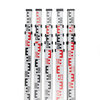
Scale Accuracy and Clarity: The scale—whether E-type, bar-code, or imperial—must be laser-etched or precision-printed to prevent wear. High-contrast coloring is vital for easy reading in various lighting conditions.
Locking Mechanism: Test the locking mechanism (usually spring-loaded) for security and ease of use. It should hold sections firmly in place without slippage.
Length and Section Count: Consider the typical measuring ranges you need. A longer staff with more sections is more portable but may be slightly less rigid than a shorter, two-section model.

Conclusion
The Aluminum Leveling Staff has proven to be far more than a simple measuring tool. Through advanced materials science and intelligent engineering, it stands as a robust solution to the three biggest on-site challenges: water, dust, and impact. Its corrosion-resistant coating, dust-shedding surface, and impact-absorbing structure ensure that your investment is protected and your surveying data remains accurate over the long term. When the success of your project hinges on precision, compromising on your foundational tools is not an option.
For any construction or surveying professional, choosing a durable and reliable Leveling Staff is a direct investment in project efficiency and data integrity. Don't settle for less.
Ready to equip your team with the most resilient surveying tools? Contact Mutoop, a leading Aluminum Leveling Staff manufacturer, today!